

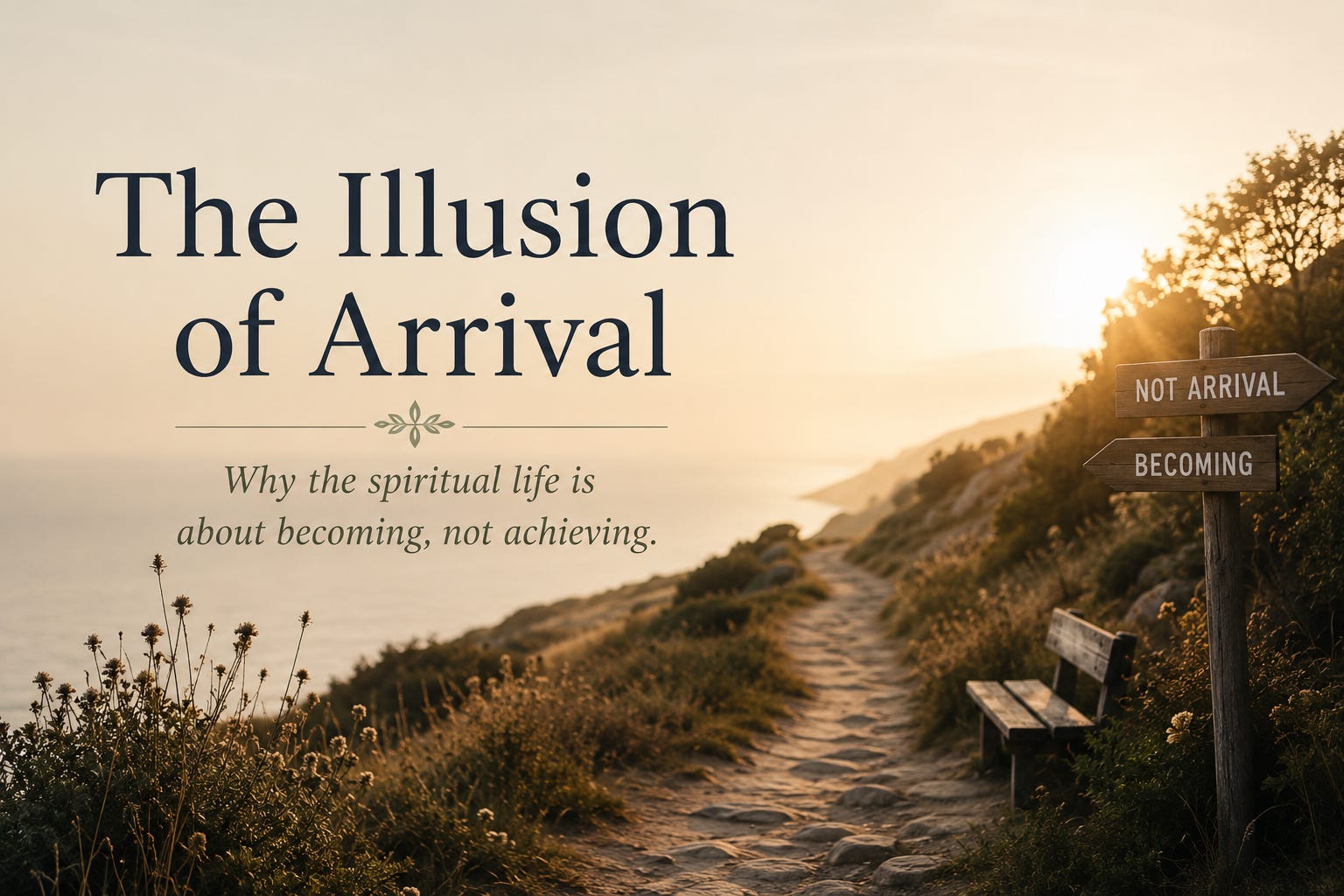
There is a question I have been sitting with lately. When do we finally arrive? Not at a destination on a map, but at that place we imagine where life will finally make sense. The place where we are successful enough, wise enough, peaceful enough, or spiritually mature enough that everything simply falls into place. If I’m honest, I think many of us carry this assumption, even if we never say it out loud. We tell ourselves:
Once I get the new job...
Once the children are grown...
Once life settles down...
Once I retire...
Once I have more time...
Once my faith is stronger...
Then I’ll finally become the person I was meant to be. The problem is that “once” has a way of moving. The destination keeps changing. The spiritual life can become another version of the same pursuit. We begin to believe that if we read enough books, attend enough retreats, pray enough prayers, or learn enough theology, we will eventually arrive at some place called spiritual maturity.
But I don’t think that is how formation works. In fact, I wonder if one of the greatest obstacles to spiritual growth is the belief that there is a finish line. The Christian life has never been about arriving. It has always been about becoming. There is a subtle but important difference. Arrival suggests completion. Becoming invites transformation. Arrival implies that one day we will no longer need grace. Becoming reminds us that grace is the very thing that carries us every day.
When I read the Gospels, I don’t see Jesus inviting people to achieve a spiritual status. I see Him inviting ordinary people into a relationship that continually reshapes them. The disciples did not “arrive.” They misunderstood. They doubted. They argued. They failed. They learned. They began again.
Over time, they were formed… not because they were perfect, but because they kept walking with Christ. That gives me hope. Because if the measure of faithfulness is perfection, most of us will spend our lives discouraged. But if the measure is simply remaining open to God’s work within us, then every day becomes another opportunity to begin again. I think this is one of the reasons I appreciate the Anglican tradition so deeply. Our worship follows rhythms. Our prayers follow seasons.
The Church Calendar reminds us that the spiritual life is not a straight line but a continual return to the story of God’s redeeming love. Every Advent teaches us to wait. Every Lent teaches us to repent. Every Easter teaches us to hope.
Year after year, we return to these rhythms, not because we have failed to learn them, but because they continue to shape us. Formation is rarely dramatic. More often, it is found in the quiet repetition of ordinary faithfulness. Showing up for worship. Praying even when the words feel dry. Listening more than speaking. Offering forgiveness. Serving without recognition. Returning to God after wandering. These are not signs that we haven’t arrived. They are the very means by which God forms us.
Our culture celebrates achievement. The Kingdom of God celebrates faithfulness. Those are not always the same thing. Achievement asks, “What have you accomplished?” Formation asks, “Who are you becoming?” One is measured by accomplishments. The other is measured by love. Perhaps the greatest illusion is believing that one day we will finally become the finished product.
The truth is, we are always being formed. The question is not whether we have arrived, but whether we are allowing ourselves to be shaped by the presence of Christ today. Maybe that is enough. Not because today’s version of us is complete. But because God is not finished with us yet.
There is great freedom in letting go of the need to arrive. The invitation of the Gospel is not to reach a destination where we no longer need grace. It is to walk with Christ, day by day, allowing His grace to shape us into people who love more deeply, listen more carefully, serve more generously, and trust more completely. That is the journey. And perhaps the journey itself is where we discover that God has been walking beside us all along.
In our weekly studies, we have determined over a period of time that the learning never ends. And that we can study the same thing and learn again something different. Your article has pointed out a couple of things that we have discussed in our class and not defined well, so thank you. This is a very good start to a new conversation for our group.